BiBlo – Von Bingen’s Blog 03
Inventio
Inventio in rhetoric is the first step for preparing an oration or a written statement. It consists of drawing up an inventory of essential information to invent arguments. In previous research (starting with my doctoral dissertation in 2018), I gathered information about the employment of signal tones. I developed hypotheses about the schemas that define their interrelations with other musical, textual and rhetorical schemas defining ‘European medieval liturgical chant’. So which information is essential I have found out in the meantime.
Schema theory is a neuropsychological concept that has proven useful describing text-music relations represented by signal tones. For an excellent introduction to what schema theory might imply for the study of this field, see: Ghosh, Vanessa E., and Asaf Gilboa. “What Is a Memory Schema? A Historical Perspective on Current Neuroscience Literature.” Neuropsychologia 53 (2014): 104–14.
To substantiate my hypotheses about signal tones, I organise information from the internet and from sources in libraries. Basic material often can be found in CANTUS . Fortunately, CANTUS provides indexes for both the Dendermonde manuscript and the Riesencodex. A selection of the fields in the CANTUS indexes for the two manuscripts I imported into Filemaker, database software I have used since 2018 for the inventio of data related to my research. I always set up one layout in which I organize all incoming information, that subsequently is analyzed in other layouts. The ‘General Input’ layout under construction looks like this:
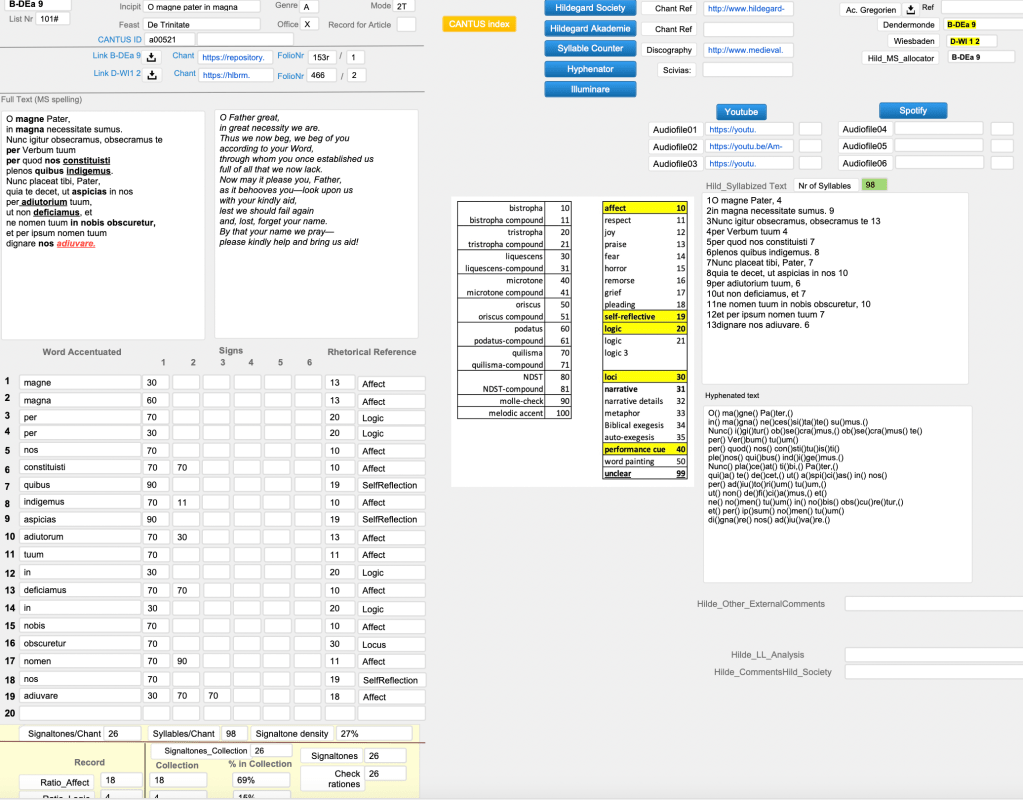
Top left, the metadata of the chant per manuscript provided by CANTUS. Underneath top-down, links to the image of the chant analysed in the digitised sources, the Latin text plus its translation, followed by the centrepiece of the database, a table with words containing signal tones, the signs employed and their rhetorical categorisation. Finally some tables with quantitative summaries about the signal tones registered per chant and in the collection selected (this can be filtered for any subcategories in the database, for instance per genre, per source, etc.).
The right hand part of this layout shows a number of buttons that open other websites I frequently use for gathering the basic stuff for this database and, if relevant, the page or subject links found for quick reference. Below these fields, audio files. I should add information from the discographies available and the chant-specific links but, as said, this is a layout under construction. The Latin text is copied into online text processors, a syllabifier and a hyphenator. The former is used to calculate relative signal tone densities per chant, the latter is the basis for transcription in neoscript by Gregorio software.
The relative signal tone density is calculated by dividing the number of signal tones by the number of syllables per chant; it enables quantitative comparisons of signal tone employments between chants, composers, genres and whatever filter you may think of. Whether it makes sense from a methodological point of view remains to be seen; I do not bother too much because the software does the tedious job for me.
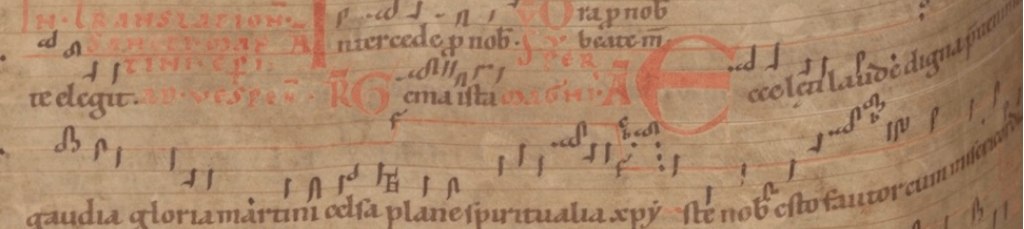
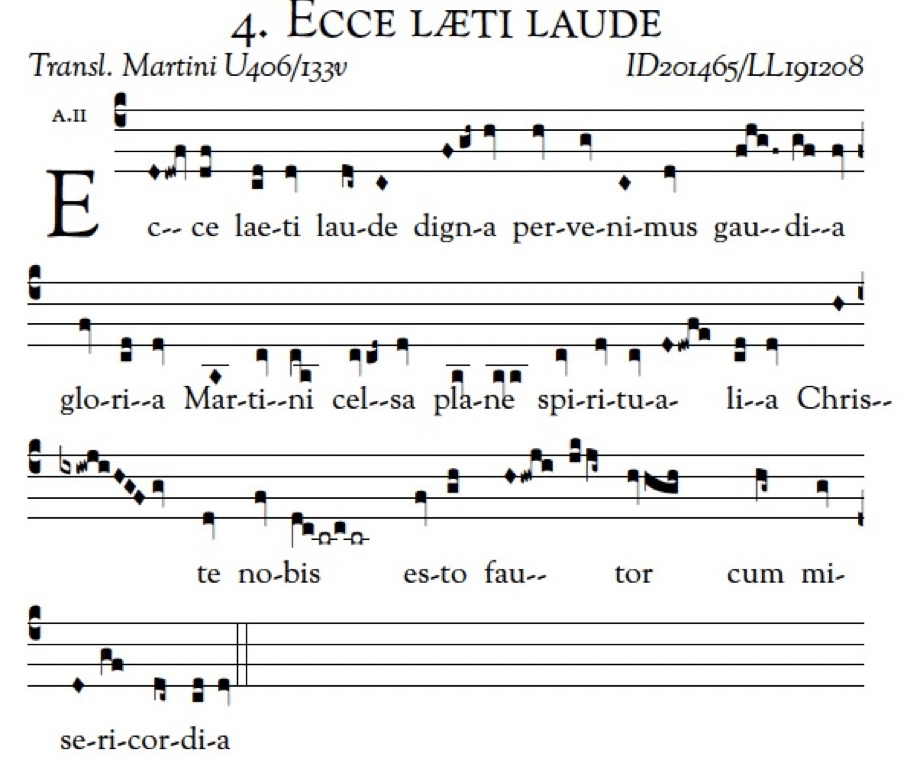
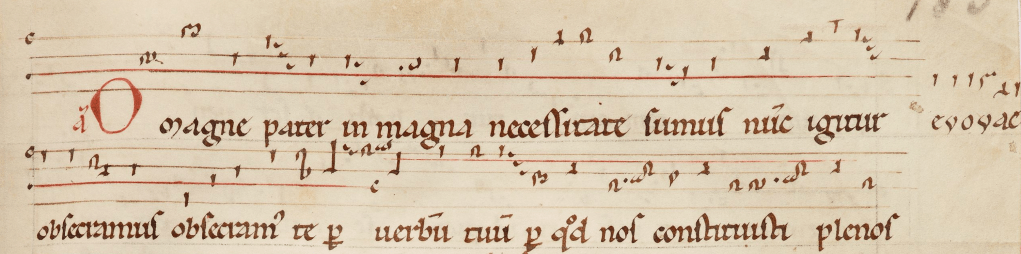
Gregorio software I use to transcribe the chants as notated in the manuscript into material that can be used by choirs. For instance, the following composition by Radbod of Utrecht (899-917), as notated in NL-Uu 406 results in the subsequent notation:
For encoding information about signal tones found in the manuscript, I keep two code tables at hand.
In other layouts in the same Filemaker database for this project, I assemble my notes from secondary literature. Separate layouts will combine the manuscript image with my findings per chant and/or filtered data from the respective manuscripts, comparisons etc.
Which signs in Hildegard’s compositions are signal tones I will sow in the next blog.
BiBlo – Von Bingen’s Blog, 02
The Sources
The chants composed by Hildegard have been notated in two manuscripts. The notation is a representative of what the Utrecht musicologist Ike de Loos in 1997 described as the Utrecht-Stavelot-Trier notation, after her analysis of sources written in this geographic triangle. The neumes are variants of the so-called Messine notation, the neumes that are characteristic for the tradition developed in Metz, France.
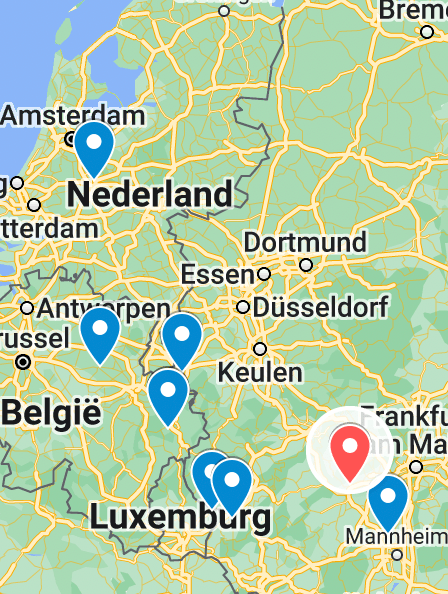
The Utrecht-Stavelot-Trier Triangle. Rupertsberg in red.
The Utrecht-Stavelot-Trier notation:
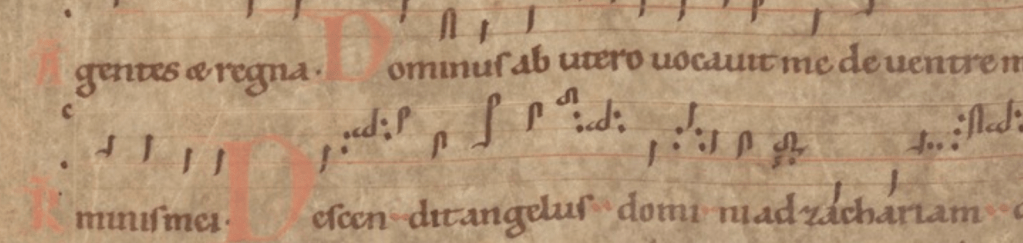
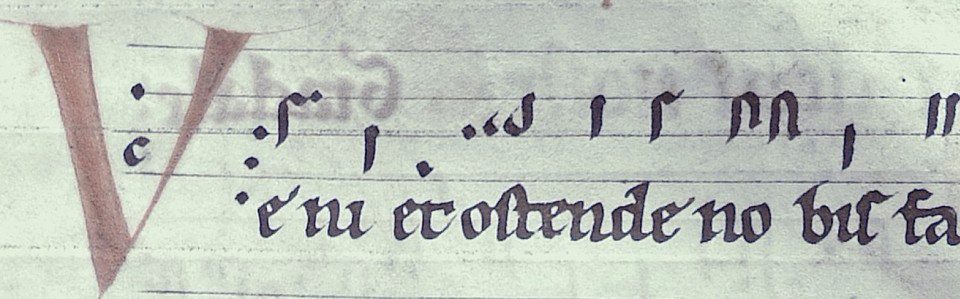
Utrecht, NL-Uu 406/ 125v
The notation of Hildegard’s compositions:
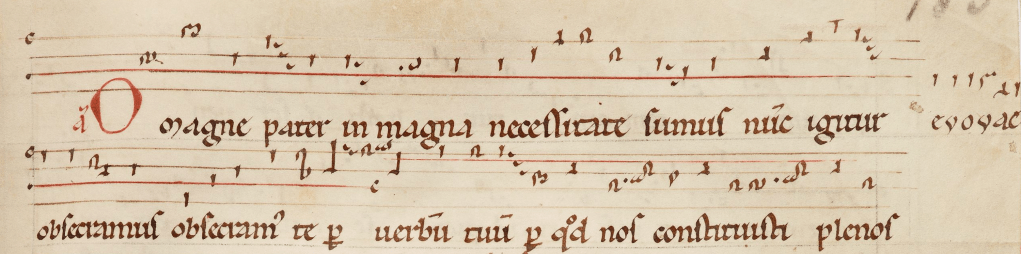
- Dendermonde B-DE a 9/f. 153r/1
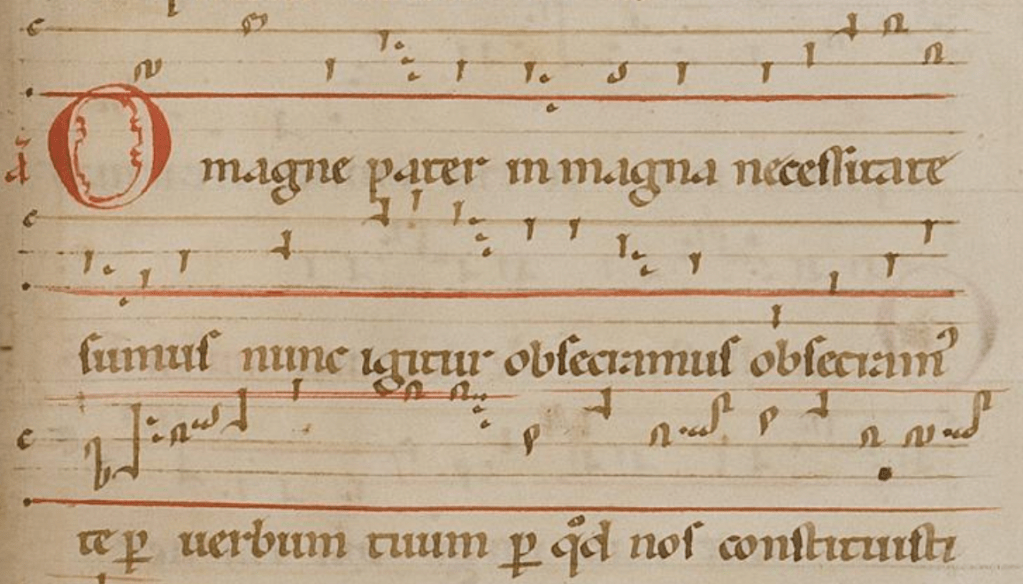
2. Riesenkodex D- WI1 2 /466r/4
Both manuscripts were produced at Rupertsberg Abbey. Dendermonde was dictated by Hildegard to her scribe Guibert of Gembloux a few years before she died; it was sent to an abbey in what now is known as Belgium and ended up in the Benedictine Abbey of Dendermonde, Flanders. Since 2017, the Alamire Foundation in Leuven, Belgium, keeps this manuscript.
The same scribe reorganised the Dendermonde version a few years after her death, in what became known as the Riesencodex, now kept at Hessische Landesbibliothek, Wiesbaden. There is some debate whether Hildegard or Guibert composed the chants.
For my analysis, I intend to select a number of chants notated in both manuscripts for comparing the employment of signal tones. Which ones will depend upon the first steps of my research into the employment of signal tones in the compositions attributed to Hildegard.
The presentation of my research’s setup is a nice step towards an introduction to rhetoric, which is the essence connecting language and music in plainchant. An orator started by gathering information and arguments that might support his explanation. This first step of the rhetorical preparation is called Inventio: drawing up an inventory and inventing arguments.
BiBlo – Von Bingen’s Blog, 01
This blog offers new perspectives on the compositions by Hildegard von Bingen. It is meant for singers and researchers.
Now, “new perspectives”: isn’t that quite presumptuous, given the avalanche of publications and recordings that pour from the screen after you put her name in a search machine?
• Yes, if you know what signal tones are;
• No, if you haven’t the faintest clue what signal tones might be.
That is what this blog is about, more specifically about the signal tones in the Symphonia composed by Hildegard von Bingen (1098-1179), at her abbey near Rüdesheim am Rhein, half an hour by car from where I had my office for almost 14 years: Wiesbaden.

What do signal tones add to our knowledge about Hildegard and her time?
Up to about the middle of the thirteenth century, liturgical melodies were notated by neumes, since the eleventh century by neumes on a staff. By that time, they could represent pitches of all sorts, dynamic accentuations, and timbral aspects. Since about the turn of the second millennium, musicologists have discovered that certain neumes (and the sounds they might represent) also are melodic codes, conveying messages about text content.
To the list of signal tones discovered in separate studies, I added microtones in 2018, synthesising previous research and my own into a new tool for analysing text by these signal tones (that I called ‘musemes’ in my doctoral thesis, but in normal language, ‘signal tones’ make more sense). All ten signs for signal tones (and the corresponding sounds) mean just one thing: “the text has rhetorical relevance”, just like the question mark means one thing: “this is an interrogative expression”. Imagine ten different signs for the question mark and you understand the concept of the signal tone. Which of the signal tones was applicable depended upon text/melody situations to which I will come back in other blogs.
Signal tones were employed all over Europe up to about 1250. Combinations of more than one symbol in one word simply meant that it was more important. If you learn the ten musical signs representing signal tones, you catch about 95% of the encoded medieval communication hidden in musical notation. No need for a BA or MA Musicology, no need to understand the signs that represent other (more standard) melodic issues.
Just ten music symbols, separate and in combination, reveal that Hildegard implanted a textual waypoint in her melody. That is the easy part; as a musicologist, I may be of some help by the blogs that I intend to publish during the next months.
Interpreting why she added them sometimes is more difficult.
Dan Brown, Templars? Kind of.
Do not expect signal tones helping you cracking the secret to eternal youth, but exciting it is for sure: signal tones are echoes of medieval minds. Learning to communicate in the Middle Ages meant studying RRR: Reading, wRiting, and Rhetoric, and it is impossible to overstate the importance of the latter. All literate people were aware that all oral, written, and symbolic communication via the arts was conveyed on a rhetorical grid. If an orator, singer, writer accentuated a word, an expression or a sentence, both sending and receiving this information was guided by rhetorical education.
In plainchant, signal tones were the sung rhetorical messengers.
Thousands of notated manuscripts still exist, written from Malta to Reykjavik and by the month, more are available for consultation for free. Have a look at the Database CANTUS and the MMMO database, to which I contributed also. The Symphonia are notated in two manuscripts, one from a Belgian Benedictine abbey in Dendermonde kept at the Alamire Library in Leuven, the other is the so-called Riesenkodex from Wiesbaden. We will have a look at them in the next blog.
Before summer, I intend to send my ‘Hildegard-signal tones’ exploration to a musicological journal; readers will be able to follow my research (not my drafts).
Comments are welcome!
 De Codes van het Gregoriaans